Bob Martin, the “Bravest Man in Lee’s Army”
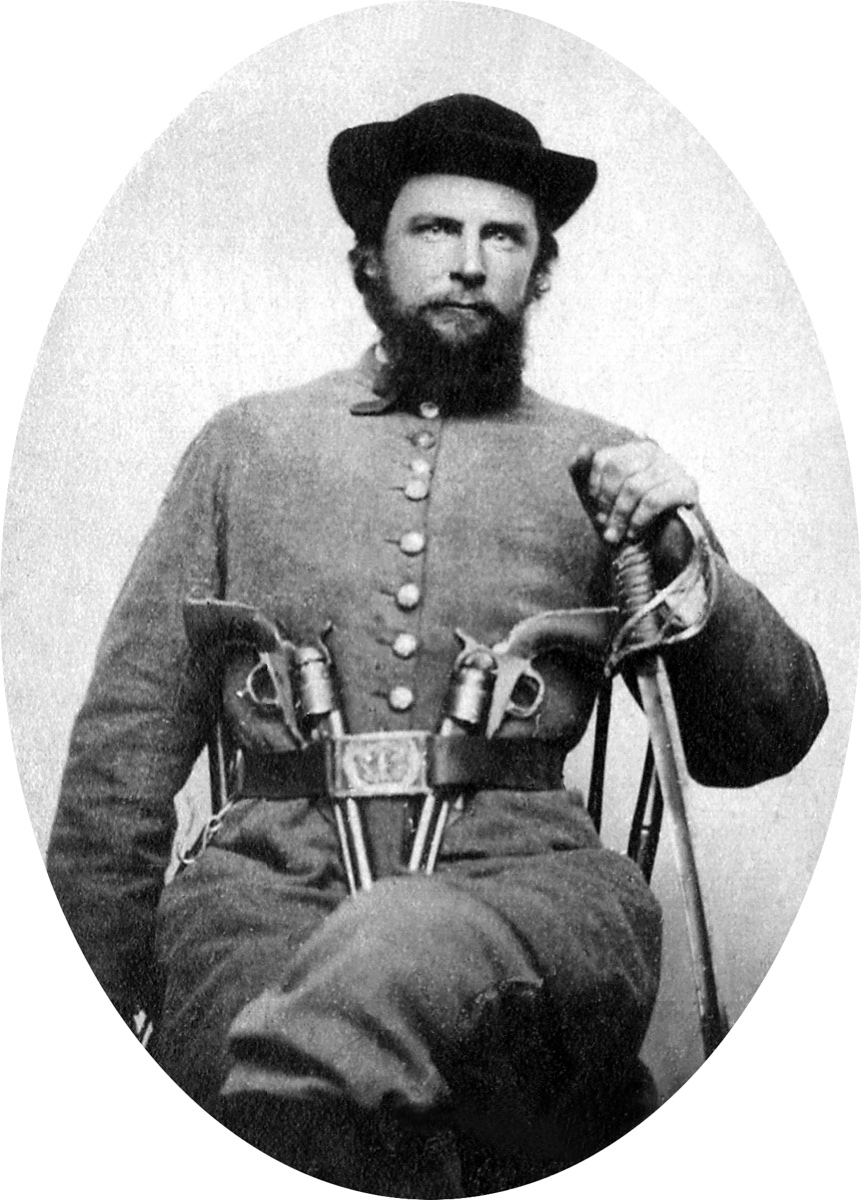
The second child of Honest John and Susan Martin, Robert Edward Martin, the “bravest man in Lee’s army”, was born 15 August 1831.[23] He was the elder brother—ten years older than Dick and twelve years older than Josh. After surviving a brutal war, he died in a farm accident a few years afterwards in 1871, only two months after the birth of his daughter and two years after his marriage.
His Black Horse Service
Bob Martin formally enlisted in the Confederate Army 25 April 1861. He was a few months shy of thirty. He served as 3rd Sergeant, then 1st Sergeant. He was wounded in January, 1864 and paroled 6 May 1865.[24]
Alexander Hunter described him best:[25]
…Robert…was the orderly sergeant of the Black Horse, and he was to the enemy’s scouts a rankling thorn. No man ever lived better fitted to back a friend or face a foe; he was the beau ideal of a cavalryman; tall, athletic, muscular, with pluck written in every line of his strongly marked face. He had certainly captured more of the enemy’s cavalry than any other man in the army. He had just received a superb rifle sent by an English nobleman to be presented to the bravest man in Lee’s army. Of course it was impossible among so many of the bravest soldiers on earth to choose one preeminently daring. Lieutenant Minor of the C.S. Navy, who was charged with the mission, forwarded the weapon to Colonel Randolph[26] with instructions. After a good deal of inquiry the Colonel presented the English heavy- bore to Sergeant Martin as the man who had committed the most daring deeds.[27] This decision caused no heart-burning in the Black Horse, as Bob Martin was the acknowledged leader in all enterprises which savored of fearful risk or dangerous undertaking.
Speaking of Martin, his former captain, John Scott, put it this way:[28]
… He appeared to court danger for itself, and it seemed there was nothing he so little valued as life. To him, by general consent, therefore, the rifle was awarded as “the bravest of the brave.”
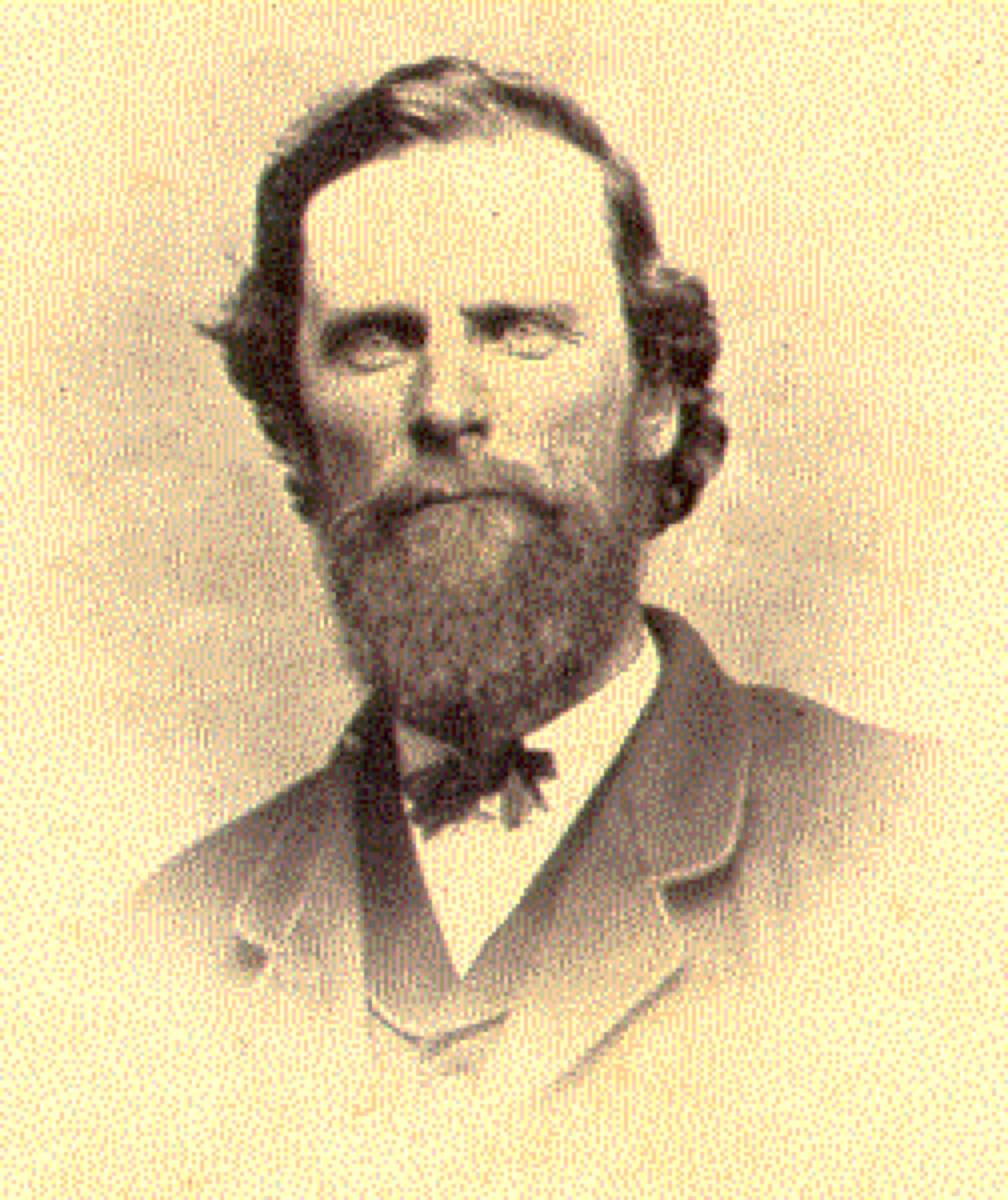
By the third winter of the war, hope for a Southern victory was dying. There had been no major military action since November. In the lull, officers caught up on their paperwork.
The Lieutenant Minor referred to by Hunter above was Robert Dabney Minor, a U. S. Naval Academy graduate and former Lieutenant in the U.S. Navy.[29] [30] He served on the CSS Virginia[31] in its famous fight with the USS Monitor, the first battle between ironclad warships, in Hampton Roads.[32]
In September, 1863, an expedition was established to free Confederate prisoners of war at Johnson’s Island, in Lake Erie, near Sandusky Ohio. The party was commanded by Captain John Wilkinson who was captain of the R. E. Lee, one of the most famous of all blockade runners. Lt. Minor was his second-in-command. The expedition was a cloak-and-dagger affair. They sailed for Halifax, Nova Scotia on October 10, 1863. The party got as far as Toronto, when the plot was discovered and they returned home.[33]
It was while in Nova Scotia that Lt. Minor received the rifle. Several months after his return, he forwarded it to Colonel Robert Randolph with the following instructions.
NAVAL ORDNANCE WORKS Richmond, Virginia, January 30, 1864 Lieut. Col. Robert Randolph, Commanding 4th Virginia Cavalry: Colonel: - While recently abroad, a rifle of peculiar make and exquisite finish was placed in my hands as a present from an English gentlemen, to any one who would make the best use of it against our enemies - or, to use his own words, -“to any one who will kill a Yankee with it”. As the Black Horse company has deservedly won a world wide reputation, I beg leave to place it in your hands, to be presented to the bravest man in that troop. I am, sir, respectfully yours, &c.,
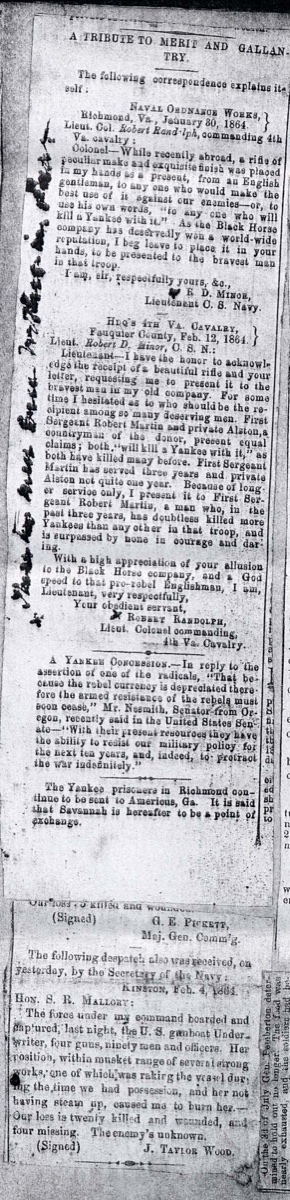
R. D. Minor, Lieutenant C. S. Navy
Col. Randolph was no doubt pleased to hear from Lt. Minor, particularly since Randolph was a former captain of the Black Horse, before he was promoted to command the 4th Virginia Cavalry. Col. Randolph replied:[34]
HDQ’S 4TH VIRGINIA CAVALRY Fauquier County, Feb. 12, 1864. Lieut. Robert D. Minor, C. S. N. Lieutenant, -I have the honor to acknowledge the receipt of a beautiful rifle and your letter, requesting me to present it to the bravest man in my old company. For some time I hesitated as to who should be the recipient among so many deserving men. First Sergeant Robert Martin and private [Harold] Alston, a countryman of the donor present equal claims; both “will kill a Yankee with it” and both have killed many before. First Sergeant Martin has served three years and private Alston, not quite one year. Because of longer service only, I present it to First Sergeant Robert Martin, a man who, in the past three years, has doubtless killed more Yankees than any other in that troop, and is surpassed by none in courage and daring. With a high appreciation of your allusion to the Black Horse company, and a God-speed to that pro-rebel Englishman, I am, Lieutenant, very respectfully, Your obedient servant, Robert Randolph, Lieut. Colonel commanding, 4th Virginia Cavalry
Lt. Minor’s daughter Landonia Randolph Minor Dashiell, in a note[35] dated 22 August 1924 pointed out that:
The allusion above to ‘recently abroad’ in my father’s letter could not be explained at the time. He had returned in Nov. 1863 from the famous Johnston Island Expedition and while in Canada, rather Nova Scotia, had met the Englishman who presented the rifle. The above letters appeared both in the Sentinel and the Richmond Wig at the time the rifle was awarded. I have copied them from my father’s confederate Scrap-Book.
According to Lt. Minor’s letter, the Englishman did not exactly say that the rifle should go to the “bravest” man, but to him that would make best use of it in killing Yankees. Lt. Minor reasonably translated the request into presenting the rifle to the bravest man. As Hunter noted, selecting the Black Horse as the company from which the “bravest man” would be selected was arbitrary in an army full of brave men. Lt. Minor justified his selection by noting the fame which the Black Horse enjoyed. Nevertheless, the award was certainly intended to be representational. The Englishman was never identified.
Word of the honor paid to Martin spread. In an April 20, 1864 letter to his wife, Warrenton newspaper editor Lycurgus Washington Caldwell remarked;[36]
I was pleased to learn of the compliment [receiving the rifle,] paid to Robert Martin, he is a very deserving young man and a splendid soldier.
Why did Lt. Minor select Col. Randolph and the Black Horse? Most likely, not only because of the fame of the Black Horse, but because Col. Randolph was his brother-in-law. Minor married Randolph’s sister, Landonia. Randolph also knew Bob Martin well because they were neighbors. The Randolph estate immediately adjoined the Martin property to the south and Randolph’s residence, The Grove, was only about a mile east along Meetz Road from the Martin Home Farm.
[Insert photo of rifle.#]
Providing more evidence of Bob Martin’s bravery, Alexander Hunter continued further:[37]
Bob Martin ought to have lived in the days of the Crusades. He would have made an ideal Sparticus, or a Jack Cade[38], for he was a born gladiator: six feet one inch in height, weighing about 180 pounds, with not an ounce of superfluous flesh, it was no wonder he was the acknowledged leader among the daring men of the Black Horse. In personal strength he was a phenomenon, and he was a quick and active as a panther. He had a good, honest countenance; his eyes were gray, and his firm mouth and chin showed the character of the man. In action he had the sternest face I ever saw, and his eyes had within them a baleful glitter that was terrifying. As a partisan he was at his best. In the autumn of 1862, when riding along an obscure road in Fauquier County, he encountered six of the enemy, and in the fight that ensued he wounded two and captured two and came out unscathed. His deeds would fill pages. On one occasion, in 1863, he visited his home and found there two of his comrades of the Black Horse. Despite his better judgment, Sergeant Martin remained with them in the house all night. That evening a Negro servant of the Martin household slipped over to Casanova, about a mile distant, and informed the Federal General Torbett[39] of the prize within easy grasp. Just after midnight the house was surrounded by a battalion of Yankee cavalry, and the officer, going to the door, summoned all the inmates to appear. Two of the Rebs gave themselves up, but Bob Martin, with a pistol in each hand, sprang through a window right in the midst of his enemies, and there was some lively shooting, but he got away unharmed. He was not only fearless, but his nerve never failed, and in moments of deadliest peril he kept his wits about him; his mind and body moved in unison, with the quickness of the lightning’s flash, and it was this intuitive action that saved him time and time again. A man madly, blindly brave, placed in position of deadly menace and peril where Martin escaped, would have met death many times. It was not Bob’s luck, but his doing the right thing at the right time that saved him. He was the only trooper in the Black Horse who, when in close quarter, preferred the saber to the pistol; and come to think of it, I never met or heard of any cavalryman except the German Colonel von Borcke, Stuart’s personal friend, who did. In the charge at Brandy Station, in June, 1864, Sergeant Martin rode a couple of lengths in advance and literally hewed his way with his saber through the opposing force. It was for a time a surging, intermingled mass of men, who feared to use their pistols unless the muzzles were jammed against the enemy’s body, and it was in that mob that Bob Martin so distinguished himself that his deeds were talked of around every camp-fire in the cavalry. Withal, there was not a touch of the desperado about Bob Martin. Outside of battle he was a reserved, quiet man, unobtrusive and reticent; he was obliging and wholly generous, and he inherited from his father his honesty and pride. Bob Martin by all laws, should have been the captain of the Black Horse, and every trooper, had he been privileged, would have voted him that honor. That such a born soldier should have gone through the war in the ranks is but one of the numberless cases of the incompetency of the Confederate Government.
After the war in April 1867, before he married, Bob Martin received the following letter from Lt. Minor. Apparently he had asked for copies of the correspondence exchanged between Minor and Co. Randolph. Lt. Minor provided them:[40]
Rob’t Martin, Esq. Sergeant, Black Horse Co. April 1867 Richmond, Va.; Box 1089 April 2, 1867 My Dear Sir, Enclosed you will find a copy of the correspondence between Col. Randolph and myself in relation to the Rifle presented to you as the bravest man in the “Black Horse” Company. Among such conspicuous and distinguished troopers, when all were brave and did their duty nobly, the designation as “The Bravest” is an honor forever to be cherished & remembered by posterity for all time to come. With kindest regards to you father and all the members of the family and with best wishes always for your welfare and prosperity, I remain with sentiments of high respect and esteem, Very Truly yours, R.D. Minor
His Marriage to Mary Virginia Childs
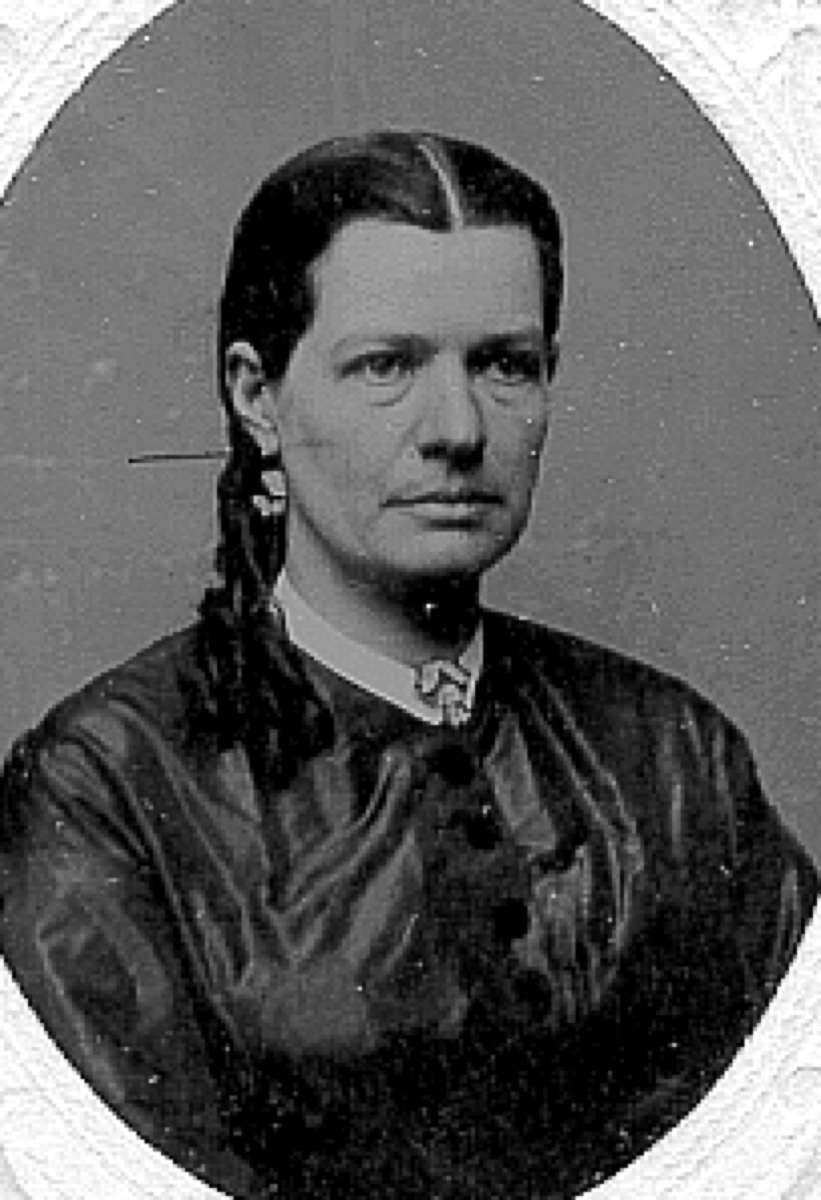
Four years after the war, the Rev. Henry H. Wyer[41] married Bob Martin and his neighbor, Mary Virginia Childs, 14 December 1869.[42] [43] He was 38 and she was 26. She was born #Ask Alice Jane Childs and was the daughter of William H. Childs and Nancy Ann Lewis. (See Childs Family Appendix.) She grew up only a mile from Bob. Her brother James had married Bob’s sister Margaret Ann 3 years earlier. The 1870 U.S. Census showed Bob and his new wife living at his father’s home farm.[44] His sister Mildred and brother Josh are also living there. Bob and Mary had one daughter, Annie Robert[45] Martin, born 10 November 1870.[46] She was almost four when she died, 2 October 1874.[47] Annie is probably buried in the Martin or Childs Family Cemetery.
Bob Martin’s Accidental Death
Ironically, after surviving a terrible war, Bob Martin was killed accidentally.[48] A sleigh he was driving, near Ajax, the home of his wife’s family in Casanova overturned by a runaway horse.[49] “His brains were dashed out on a rock.”[50]
His brother Dick wrote this sorrowful and eloquent obituary: [51]
Thrown from a sleigh and killed, on the 29th of January 1871, Robert E. Martin of Fauquier County Va. Such is the announcement that carried sudden grief to the hearts of friends and comrades, sorrowing over the untimely death of one whose earnest voice they are never more to hear, whose cordial grasp of hand they are never to feel. Unlooked for, unwarned, death came in the danger that was hardly feared as such, and he who had passed through the rain of shot, the terror of war, yielded up his life, and was numbered with the dead. The beautiful and spirited horse, harnessed for the first time, dashes down a steep hill, and he refusing to jump from the sleigh, as did his companion, whishing as he said, to restrain and “conquer her”, stands with every nerve braced and the fiery gleam of old in his eye, and speeds to his death. A sudden shock! A crash! And he is hurled with terrific force against a rock; and what was but a moment before a mortal, in the full flush of manhood, of splendid physique, and perfect health, lies now stilled- bleeding – dying. No words have passed the lips – the poor head is crushed, and piteously mangled, and in a few hours they say of him that he is dead. During the late civil war Robt. Martin was first Sergeant of the Black Horse Cavalry. Probably no more magnificent specimen of a soldier ever lived; perfectly fearless, the field of battle was his proper sphere; foremost at the head of his Squadron, in every dashing charge, and hindmost with the rear guard in every stubborn retreat, he seemed to court danger where death fell thickest; but through shot and shell he passed as though he bore a charmed life. Many of the exploits, now traditions of the region where they happened, were so utterly desperate, so full of a superb madness, as almost to defy belief. In 1863 a very handsome rifle was sent from England by a “Sympathizing Nobleman” to be given to the bravest soldier in the Confederate army and though to comply with the literal meaning of the bequest was impossible, yet it was presented to Sergeant Martin, as the soldier who as far as was known had performed deeds of greatest brilliance & daring. And so he passes from us, remembered and beloved, Brave as a Coer de Lion,[52] with honor as fair as day; true as steel to his convictions. [Insert photo of part of handwritten obit.#]
We even know exactly where the accident occurred. Fauquier outdoorsman Randy Carter recorded the following in his diary in 1952:[53]
Bob Martin’s ghost? When I was 16 [1920] I was coming back from Warrenton to Melrose[54] where we were spending the summer. I was horseback on “Daughter”, a wonderful saddle horse, it was near midnight, as we entered the deep cut in the road on the Melrose side of Turkey Run[55] my horse stopped dead and refused to go thru the cut. No amount of kicking or beating would make her go a step further- It was too dark for me to see anything, and I wasn’t going to get off. While wondering what to do my horse started trembling violently- it was contagious and I became terrified- at what I do not know. I turned her around out of the cut and thru the woods, scared to death. Last year- thirty years later- I learned that it was here that Bob Martin’s horse had run away, and he fell from his cart and was killed. Does this explain the fright experienced by my horse and then by me? That was 32 years ago to be exact.
Bob is buried next to his brother Josh Martin in the Martin family cemetery. His grave is a small, rough stone marked only “R. E. M.”
Insert Photo of his gravestone#.
Mary Virginia after Her Husband’s Death
After his early death, Mary Virginia lived over forty years with the memory of her husband. Although only 27 when Bob died, she never remarried. She lived with family members, so there was probably less economic pressure on her to marry.
In 1880, fifteen years after the war, Mary Virginia (43) and her sister Margaret Ann’s son—her orphaned[56] nephew Earnest Lee Childs (10)—were living in the household of her brother, William L. Childs (age 55.) William’s sister Rebecca D. (age 46,) and a nephew, William Johnson (36,) also lived there as well as two servants and a farm laborer. [57]
Twenty years later, in the 1900 census,[58] Mary Virginia was still living with her brother William. She says she is 60 and born May 1840.[59] Ten years later, in 1910,[60] she was still living with her nephew Earnest Lee, but he is now the head of household. He was still single. Her age was given as 75. She was shown as having had one child [Annie], who was not living.
Mary Virginia died February 4, 1912.[61] She is buried in the Childs Family Cemetery. Two months after her death, her nephew Ernest Lee married.[62] One wonders if he waited until he no longer needed to help his aunt.
[get photo of all tombstones in cem.#]
The following is her obituary: [63]
Mrs. Mary Childs Martin departed this life at the home of her nephew, Mr. E. L. Childs, Casanova, on Sunday, the 4th inst. [4 February, 1912], aged 81 years. She was the youngest child of Wm. Childs, a native of Culpeper County, and Ann Lewis, of Fauquier. Both families were prominent early English settlers of Virginia. Mrs. Martin’s husband was a member of the distinguished Black Horse company and a gallant soldier of the confederacy. He was accidentally killed a few years after the close of the Civil War. This subject was in every way a superior woman, of good presence, sensible and generous, kindly, hospitable and with all a consistent Christian. She was a member of the Broad Run Baptist Church on the books of which her mother, brother, and sister have stood enrolled four scores of years. Few people have done more in an unostentatious way than she, and none have higher praise from those who were privileged to know her. Many relations in this and other states will be saddened by the news of her death, yet it is their blessed privilege to mourn not as those without hope. She was buried at Ajax, the home of her father,[64] on Tuesday, the 6th inst., by her friends and neighbors; her pastor, Rev. V. H. Council, conducting the services. *Editor’s Note: A faint pencil line is drawn through Culpeper County, so there is a question as to whether or not this was where Mr. Childs was from originally.
See the appendix on the Childs family for more information on her family
Why Is Bob Martin Unknown Today?
Why have most people never heard of Bob Martin? After all, lesser heroes have become much better known. The reason is because he died so soon after the war. Heroes thrive best in historical memory if they either die committing a courageous act, or live long enough after the war to receive the attention of middle-aged veterans revisiting the deeds of their youth.
Bob Martin survived the war, but died twenty years before the resurrection of the sentiment of the Lost Cause in the 1890s when veterans of both armies began to organize and hold reunions to recount and celebrate their military service. Bob Martin, “the bravest man in Lee’s army,” died too soon; he became lost in a historical never-never land.