The Parents, John and Susan Martin
In the later half of the nineteenth century, Meetz Road (formerly the Fredericksburg-Warrenton Road) was a busy thoroughfare in Fauquier because it closely paralleled the railroad spur from Warrenton to the main Southern Railway line at Route 28. [What was name of RR then?#]
Today, a drive from Warrenton East on Meetz Road takes you through a countryside that is still mostly rural and residential with large farms under cultivation. After about six miles you come to Beech Road (formerly Shumates Mill Road) on the right, then in three hundred yards, to Casanova Road on the left. This latter intersection is known as Godfrey’s Corner.
Further along Meetz, you pass The Grove, a Randolph family home,[297] then Crocket Park (the center of the original Germantown settlement), and Eastern View, where Robert E. Lee visited as a child, finally arriving at Route 28. It is an old and historic road.
When you reach the intersection with Beech Road, and gaze to the west, you are looking towards the center of the 405 acre farm of Honest John Martin and his wife Susan A. Fisher, the parents of the Martin brothers. They were prosperous members of Fauquier’s landed gentry.
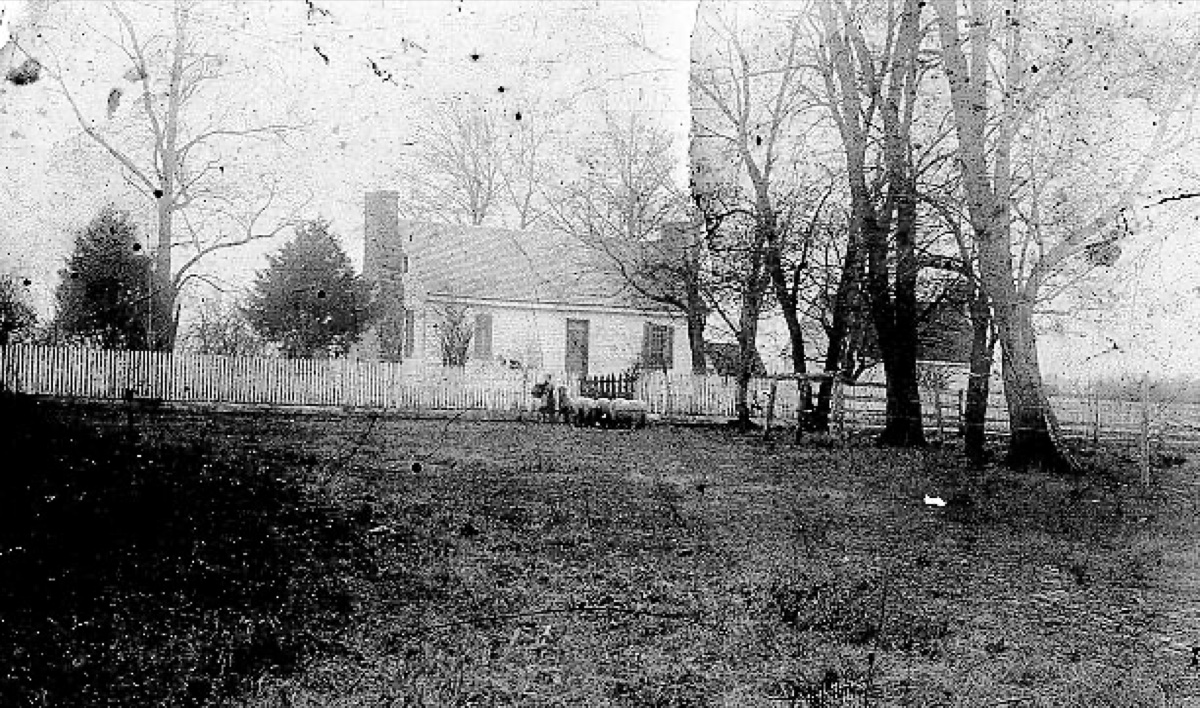
If you examine a current county tax map, you will find that the original boundaries of the farm are undisturbed, although the property has been divided, over the years, into many parcels. The land is mostly wooded now, but about three hundred yards down Beach road, and two hundred yards into the trees to the south, lays the burned out shell of the Martin Home Farm residence.[298]
The Marriage of John Martin and Susan Fisher
John was the son of Elias Martin and his first wife Mary Mountjoy.[299] [300] (See preceding chapter for details on the Elias Martin family.) John’s wife Susan A. Fisher[301] was the daughter of William Thomas Fisher and his first wife Mary Frances Gordon—a very prosperous family with roots in Stafford County. (See Appendix 4 for details.) “Honest”[302] John Martin was born 8 October 1796.[303] Susan A. Fisher was born 10 March 1803.[304]
In 1829 Rossini’s William Tell opera opened in Paris; the first steam locomotive began service in Pennsylvania; Barnum’s circus displayed the “Siamese twins.” According to the Martin family bible, 32-year-old John and 25-year-old Susan were married 13 January in Fauquier County,[305] by Rev. John Ogilvie, pastor of Upper Goose Creek Baptist Church.[306] [307] [308] [309] Thirty-two was perhaps a little late for a man to marry, but there is no evidence of a first wife.
John Ogilvie reports that he married both John and John’s sister Mildred (to Lewis Shumate) on the same day, 12 January. However, the Elias Martin Family Bible lists 15 January for Mildred and 13 January for John, two days apart. The bible is not available for examination, only a transcription. It is possible that this contained errors from difficult-to-read writing. I wonder if the families would incur the logistical burden of two weddings just two days apart. One wants to believe Rev. Ogilvie’s date and a double wedding ceremony.
The Children of John and Susan
John and Susan had nine children, seven of whom survived infancy, including three Black Horse Cavalrymen. In order of birth they were:[310]
-
William Thomas Martin. He was born 8 February 1830. He was named for his mother’s father, William Thomas Fisher. He is shown in his father’s household in the 1850 census at age 20.[311] He is not shown with the family in the 1860 census. He may have predeceased his father since he was not mentioned in his will. Since, unlike his three brothers, he was not a member of the Black Horse Cavalry, he probably died or moved away before 1861. No will or land record [check titheables, personal property tax records.] was found for William Thomas in Fauquier records. He is the only one of his siblings for whom we do not have a death date.[312] We know nothing else about him. [look 1860 census.]
-
Black Horse Cavalryman Robert Edward “Bob” Martin, who received a rifle as “the bravest man in Lee’s army.” He was born 15 August 1831. He married his neighbor Mary Virginia Childs. He died accidentally at age 39 in 1871.
-
Mary Frances Martin. She was born 3 April 1833 and died in infancy 5 August 1834. She was named for her mother’s mother, Mary Frances Gordon.
-
Elias F. Martin. He was born 15 December 1834[313] and died in infancy, 20 Dec. 1835[314] He was named for his grandfather, Elias Martin.
-
Margaret Ann Martin. She was born 4 September 1836. She married her neighbor, Black Horse cavalryman James H. [ask Alice Jane about middle initial.#] Childs, and brother of Mary Virginia Childs. She died at the young age of 37.
-
Mildred Lee “Minnie” Martin. She was born 31 October 1838. She never married. She is probably named after her father’s sister, Mildred Waggoner Martin. She was 81 when she died in 1919. _need her death certificate too-check might already have#.
-
Susan Elizabeth “Bettie” Martin. She was born 9 July 1841, twin to John Richard. She married Black Horse cavalryman William A. Bowen, Jr. She is probably named after her mother Susan A. Fisher. She died in 1933, aged 91, and 136 years after the birth of her father. She was the last to die of her siblings.
-
Black Horse Cavalryman John Richard “Dick” Martin. He was born 9 July 1841, twin to Susan Elizabeth. He married Jemima Gilmore, then Mary Gregory. He died at age 74.
-
Black Horse Cavalryman George Washington[315] “Josh” Martin. He was born 2 February 1844.[316] He never married. He is named for his father’s brother George Washington Martin. He lived only to age 52.
These children were born over a fourteen-year period from 1830 to 1844. Susan Martin would have been 26 at the first birth and almost 41 at the last. This is a wide span of years, but not uncommon then.
The chapters that follow will sketch the children who survived except William Thomas.
The 1850 Census
The 1850 Census shows the family in Fauquier.[317] In the census index, John’s name was recorded as Marton instead of Martin. The census information is supposed to be as of October 10, 1850. This is the last trace of William Thomas Martin.
The Martin Family During the War
One of the members of the Black Horse was Fauquier’s Alexander Hunter. In his book Johnny Reb and Billy Yank, he described the Martin family thus:
In small squads, traveling by unfrequented roads, the Black Horse made their way into Fauquier without being discovered. Scattering through the country among families and friends, each man was cautioned to be ready at any moment, day or night, to obey any summons from their officers. Horses were kept in the depths of the woods, as stables were considered too dangerous in those times. I was billeted for Mr. Martin’s, the home of the celebrated Martins, of the Black Horse. This snug little home, sitting back from the main road, some six miles north[318] of Warrenton, furnished three soldiers whose skill and gallantry made their name a household word among the cavalry corps…The father, old Mr. John Martin,[319] was, taking him all in all, one of the noblest types of manhood I ever met; I never expect to look upon his like again. A nature so true, so noble, so honest that he impressed all who met him as being a man of strong individuality. By those who knew him intimately he was admired for his grandeur of character and loved for his big, generous heart. He was my ideal of a patriot, and when with him I always thought of Cincinnatus, the noblest Roman of them all. Mr. Martin loved his State and the cause she had espoused with all the might of his strong nature, and with a singleness of purpose which is rarely met with; he had no thought which was not connected with the welfare of his State. He was a large landed proprietor, the possessor of two spacious farms lying near Warrenton Junction. At the outbreak of the war he was a man of means and owed no man a dollar. When the tide of conflict surged to his doors he threw them wide open and gave everything he had to the soldiers and held absolutely nothing back. His house was the rendezvous for all the Black Horsemen in the vicinity. Any straying scout applying for shelter was naturally directed to the Martins; their house was always full; thousands and thousands of soldiers were fed there during the four years of warfare, nor was there a straggling Northern soldier turned from his door. He had a stout heart, that old white-haired gentleman, standing calmly by and watching the destruction of his crops, the capturing of his stock, the dismantling or burning of his fences, stables and barns and the general pillaging of his estates by his foes, without a murmur. He seemed endowed with a sublime philosophy. He commenced life as a poor man and had slowly and patiently, in a half-century of incessant toil, made himself and family comfortable, and now with the calmness of a Stoic he stood by and saw the labors of a long life destroyed. He made no threat, no plaint, nor indulged in any repinings. He was the type of many Virginia planters and farmers too old to shoulder a musket. He was proud of his three sons, and they revered the
old Man.’ Nothing pleased Mr. Martin so much as to get his house filled with theCracks’ of the Black Horse and listen to their tales of `Derring Do’.[320]
Another time, Hunter described the family again:
At the outbreak of the war, a stranger would see, nestled away in ……add more-----.[321]
At the dedication of Josh Martin’s grave marker, Alexander Hunter also said this about John Martin:
We cannot give our loving tribute to our dead comrade without speaking of him from whom he inherited his many lovable qualities, for “like father, like son.” After all I question if the real heroes of the late war were not the great, brave, patient people; their mental agony was harder to bear than our physical pain, and watching, waiting and hoping with breaking hearts for the loved ones facing death was a trial to all, but to those families within the enemy’s lines, cut off from all communication with the outside world, as was Fauquier county, the experience filled the cup of their adversity to the brim. How well our old host John martin, his devoted wife and daughters bore the ordeal we all know. It was Theodore Parker who wrote, “The most useful man is the greatest.” Then judging by that standard John Martin was great indeed, for every hour of his life was jeweled with some good deed to his fellow man. But, it was to the Black Horse Cavalry that the tendrils of his heart clung so lovingly and tenaciously. In their successes he rejoiced, in their deaths he sorrowed as a father for his son. And to his eldest born, the daring fearless Robert, that the ideal type of a southern trooper, the pride of old Fauquier in the days agone, he too has left a name that is immortal.
Black Horseman J. K. Taliaferro also complimented the family. [322]
I must not fail to mention the noble parents and sisters of these gallant soldiers. When the war commenced, the martin homestead, about five miles southeast of Warrenton, Va., was occupied by the aged parents, three sisters, and the three brothers mentioned. After the army left Manassas in the spring of 1862, this section of country was continuously subjected to occupation by Federal armies and raiding parties, who devastated it, and frequently the inhabitants were on the verge of starvation. But all through this trying time the pluck, patriotism, and interest for the comfort of Confederate soldiers was proved by the risk of life and forced submission to the destruction of property owing to the care for any Confederate soldier who my present himself for information as to the location of the enemy, food, or shelter; and through everything in the way of provisions visible was wantonly destroyed, none were ever turned away empty. Language would fail to express the hardships to which these good people were exposed or the cheerful self-denial in the interest of a cause to which they were so truly devoted. After the surrender many sought their hospitality and were cheerfully received and made to feel at home until some employment was secured or they could go to the homes they had left to cast their lot with the Southern cause. Two of the sisters represent the family now at the old home. May they ever be remembered by those who can still recall with appreciation their hospitality and tender care!
In John’s son Josh’s obituary, the writer noted:
Courage, truth and honesty was an inheritance from the best of fathers known to all of his associates as “HONEST John martin” and no man in any age more richly deserved that sobriquet.[323]
Writers repeatedly referred to the strength and determination of the Martins.
After the War
The war had ended and Confederate soldiers headed home. In Fauquier they found a devastated county. “Because there was not a stand within three miles of town, in December, 1865, wood sold for five dollars a cord in Warrenton.” [324]
On October 23rd [1865] presiding county court justice William H. Gaines penned the following words to none other than “His Excellency, the Hon. Andrew Johnson, President of the United States. Four years of war have so impoverished the people of this County, that much suffering for the necessaries of life has occurred, and that much more must occur the coming winter, that the crops of 1862, 63 & 64 were generally used or destroyed by the passing armies, that the crops of the present year are very inadequate to the wants of the people, that the live sock has nearly disappeared, and that there is no prospect for amelioration in the condition of the people before the end of the next year. In the midst of such destitution with many dwelling houses and farm buildings destroyed or in ruins, with more than half the arable land of the County turned into common for want of fences, and no adequate force of horsed, oxen & labor, to cultivate the enclosed land, the tax gatherer has appeared amongst us, demanding …twenty seven cents upon each one hundred dollars of land of the valuation of 1860-which in the aggregate amounts to a very large sum of money, greatly more than is believed to be possessed by the entire population of the County.”
Lt. William McNulty was the agent for the Freedmen’s Bureau in Warrenton. On 10 February 1865 he had John Martin arrested. Martin had gotten into a fight with a Negro who was hunting on his property. “The arbitrary arrest shocked locals, and was exacerbated by Martin’s returning from a few days’ detention in Richmond a sick man.”[325]
Martin marriages came quickly after the war. Three of his children married in 1866, 1868 and 1869.
The 1860 U. S. Census[326] reported that John Martin’s real estate was valued at $11,546 and his personal property at $10,122. Five years after the war, the 1870 U. S. Census[327] found John Martin as a farmer, age 73 with his wife Susan, age 66, keeping house. Children at home included Mildred, 30, George W., 24, Robert E., 37 and Robert’s wife Mary V. [Childs], 33.[328] His real estate was now reduced in half to $6,500 and his personal property to $900, one tenth of the pre-war value. He put all that he had at risk to support the Black Horse. When John Martin died in 1876, he divided his property between his wife and children. He and his wife died in much reduced circumstances, the war taking a heavy toll as Alexander Hunter noted.
John Martin’s Death
“Honest”[329] John Martin died at his farm in Fauquier, “ Tuesday, the 25th day of July 1876, aged 79 years, 8 months and 17 days,”[330] [331] two months shy of 80, in the year that Alexander Graham Bell invented the telephone. His grave is not marked, but is surely in the Martin Family Cemetery with the graves of his wife and father.
John Martin’s Will
He wrote his will[332] 4 November 1875, about ten months before his death. He left 274 acres of his home farm to his wife Susan for her lifetime. At her death the property was to go to his son George W. Martin, “in consideration that my son George W. Martin will have the care of his mother & sisters.” He divided the rest of his home farm and his Licking Run farm among his daughters Mildred and Susan, his son Dick and his daughter in law, Margaret Virginia Childs (widow of Robert E. Martin,) and her son, Earnest Lee Childs.
Susan Martin’s Death
Susan died 9 August 1879[333] at age 76, three years after her husband, and one year after Gilbert and Sullivan’s musical comedy H. M. S. Pinafore opened in London.[334] She is buried in the Martin Family Cemetery.
The Martin Farms
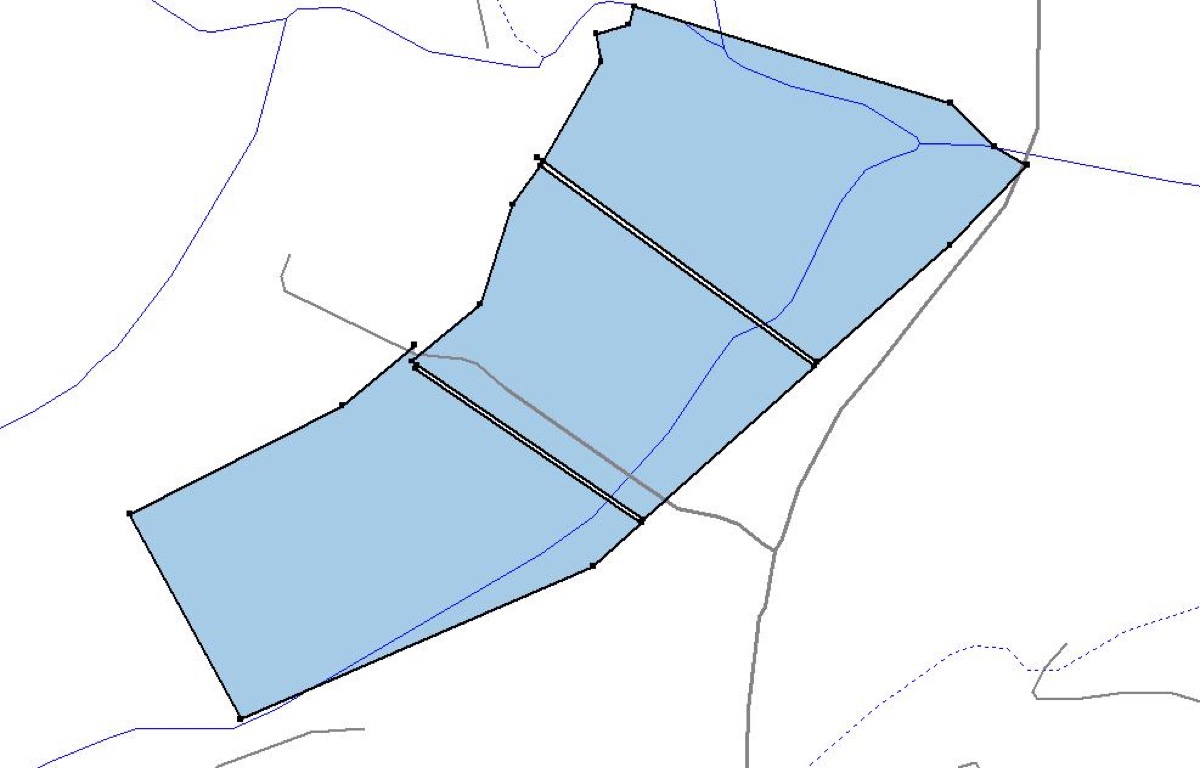
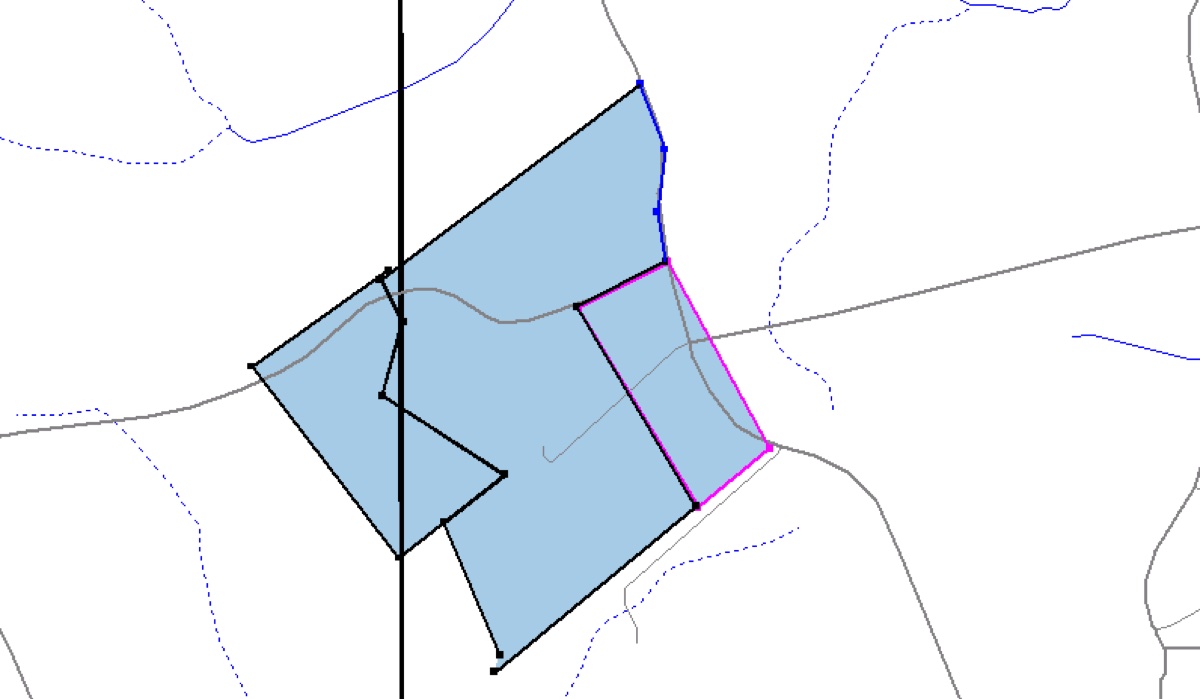
Where did they live? John Martin owned two farms near the Casanova section of Fauquier County. The largest, at Godfrey’s Corner, was 405 acres. He called this tract his “Home” farm.[335] His other farm, about two miles away and of about 352 acres, he called his “Licking Run” farm.[336] Both farms were near the old Germantown Settlement along Licking Run. Each was about two miles from lot 11 at Germantown. The lot bequeathed to John Richard Martin, part of the Licking Run Farm with the family cemetery, stayed intact for over 115 years. Only in the late 1990s was it partially subdivided into residential lots. About 75 acres of the original 100 acres is intact and contains the Martin family cemetery.[337]
When John Richard Martin sold the land out of the family, the cemetery was reserved for the exclusive and perpetual use of his descendants.[338]
The Martin Family Cemetery
Only financial hardship would have kept this ordinarily affluent family from marking the graves with tombstones. Although he is surely buried there, no tombstone has been found for Honest John Martin. His wife Susan has only a modest field stone marker, and his famous son Robert E. Martin has only a small, low, rude stone with “R. E. M” chiseled roughly on its face. His father Elias Martin has a similar stone.
In summary, we know the following Martins are buried there (the source is in parentheses):
- Elias Martin, Honest John’s father (marker.)
- Susan Fisher Martin, Honest John’s wife, (marker.)
Also the following children of Honest John and Susan Fisher Martin:
- Robert Edward Martin (marker.)
- John Richard Martin (obituary.)
- George Washington Martin (marker.)
- Mildred Lee Martin (obituary.)
There is a marker inscribed M. F. M., born April 1868, died November 20, 1882.[339] We do not know this child who died at age fourteen.[340] [Look up Fauquier Deaths.#]
Susan Elizabeth Martin is buried in the Warrenton Cemetery. Her husband William A. Bowen, Jr. is buried in the Martin Family Cemetery.
Margaret Ann Martin is buried in the Childs Family Cemetery, in Casanova, with her husband.
Thus, all the adult children are accounted for except for William Thomas Martin. The cemetery is overgrown and not maintained.