Art & Collection
Native Sons: The Black Horse Cavalry
Painting by Don Prechtel · 1985 · Image Size: 24¼" × 18¼"
Biographical sketches of the members of the Black Horse Cavalry used as models
for Don Prechtel's painting, compiled by Lynn Hopewell.
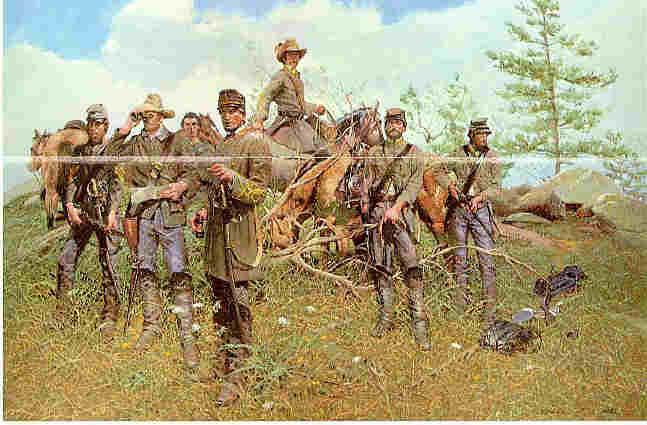
Native Sons: The Black Horse Cavalry, Warrenton, Virginia — Don Prechtel, 1985
First from left
Robert Edward Martin
First Sergeant
Bob Martin was awarded a rifle as the bravest man in the Confederate Army. How it happened
was told by John Scott, the first Captain of the Black Horse:
The regiment to which the Black Horse was attached was now, for a time, camped near
Hanover Court-House, and while here an interesting incident took place. An English officer,
who warmly sympathized with the Southern cause, presented, at Nassau, to a captain in the
Confederate navy a rifle of beautiful workmanship, which he desired him, on his return to
Richmond, 'to present to the bravest man in the Confederate army.'
The naval officer, embarrassed by the scope of his commission and not knowing, to be sure,
where he should find the bravest soldier in the Southern army, thought he could best fulfill
his commission by giving the rifle to Captain Robert Randolph, to be by him presented to
the bravest man in the Black Horse Cavalry. But Captain Randolph was as much embarrassed
in the execution of this commission as the naval captain had been, for how was it possible
for any one to say in that command who was the bravest man?
Robert Martin was the first sergeant, and in that capacity had displayed the highest
qualities of a soldier, and had, in consequence, won the esteem and respect of his men
and officers. Robert Martin, too, was foremost in every fight. He appeared to court danger
for itself, and it seemed there was nothing he so little valued as life. To him, by general
consent, therefore, the rifle was awarded as 'the bravest of the brave.'
— John Scott, first Captain of the Black Horse Cavalry
Bob Martin was the son of "Honest John" Martin. The Martin home was often used as a
rendezvous for the company. Bob Martin's two brothers, George W. "Josh" Martin, and
J. Richard Martin also served with him in the Black Horse.
Second from left
Nimrod Milton Green
Private
Born near Paris, Fauquier County, July 31, 1827. His parents were John and Elizabeth
Hitt Green who died in his early childhood. He was raised by his mother's brother,
Dr. Nimrod M. Hitt, in Augusta County at "Mountain View," near Greenville. After he
grew up, he returned to Fauquier where for some years he was a law officer, then
called a constable.
He was an original member of the Black Horse, joining in 1858. He was taken prisoner
in Warrenton in 1862 and later paroled. Captured again on April 2, 1865 at Petersburg
and imprisoned at Point Lookout, Maryland. Released June 13, 1865. He survived the
war without any wounds, by sheer luck, as he had holes shot through his hat and clothes.
…one of the best soldiers in the Co. & was most highly esteemed by the officers &
members not only by the Co. but by the regiment…but, if they all were living, they would
join in my testimonial that your father, Nimrod Green, or Nim, as we loved to call him,
was one of the best soldiers in the command.
— A fellow cavalryman's tribute
After the war, he married Amanda Virginia Wheatley of "Laurel Hill" in Culpeper County
near Rixeyville, and fathered five children. He spent his last years as a farmer and
took an active part in promoting public schools in Augusta County. He was also a member
of the school board, an appraiser and tax collector. His ancestors remember him as a man
who loved dancing and hunting. Died February 21, 1882. Buried in the Hitt family burying
ground near Greenville, Augusta County, Virginia.
Third from left, hatless
George W. "Josh" Martin
Private · Born February 2, 1844 — Died February 24, 1894
Josh was Bob Martin's brother. The Black Horse served with Early in his Shenandoah
Valley campaign of 1864. Josh Martin killed Lieutenant John Meigs, son of Union General
Montgomery Meigs, who served on the staff of General Sheridan. From the records of the
Southern Historical Society:
During this campaign… George W. Martin and Campbell, of the Black Horse, with a member
of the First Virginia Regiment, were returning from a scout late in the evening. It was
raining, and the soldiers had their oilcloths thrown over their shoulders, which in a
great measure concealed their uniform. On looking back, they saw three mounted men coming
up behind them, whom they inferred were Union soldiers… Drawing and cocking their pistols,
they rode slowly, that they might be overtaken. The Federals had had their suspicions
aroused, and also prepared for the fight. As soon as they came alongside of them, the
scouts wheeled and demanded a surrender, when they were fired upon by their opponents.
They proved to be Lieutenant Meigs, of Sheridan's staff, and two orderlies. Lieutenant
Meigs' shot passed through Martin's body, but he braced himself, returned the fire, and
killed Meigs.
— Southern Historical Society Records
After the war closed, General Meigs, believing that his son had been assassinated, sought
to have Martin arrested and tried by a court-martial for murder; but when the facts were
certified to him by Captain A. D. Payne, the matter was dropped, for Lieutenant Meigs had
been slain in open and legitimate war.
I have seen him in the advance dismounted, his eyes blazing with the flame of battle, and
his voice rising above the rattling fire of carbines, cheering his comrades on; and I have
seen him stop, and with a pitying tenderness give his canteen to a wounded enemy lying in
his path… and this much can be said, that among the many prisoners he has captured on his
scouting expeditions, he never ill-treated one by word or deed.
— Alexander Hunter, member of the Black Horse Cavalry, author of Johnny Reb and Billy Yank
At death he was hailed as "the most famous" of the Blackhorsemen. With his brother Bob
dead, and his brother Dick living in Missouri, Josh became the symbol in Fauquier of the
achievements and fame of the three Martin brothers.