Company H · 4th Virginia Cavalry · Black Horse
Channing Meade Smith
1842–1932
Confederate Service Record
Enlisted 25 April 1861; horse badly wounded 4 October 1861 Pohick Church; detached as scout July 1863 to April 1864; transferred to 43rd Batt. Cav. 12 November 1864; wounded twice.
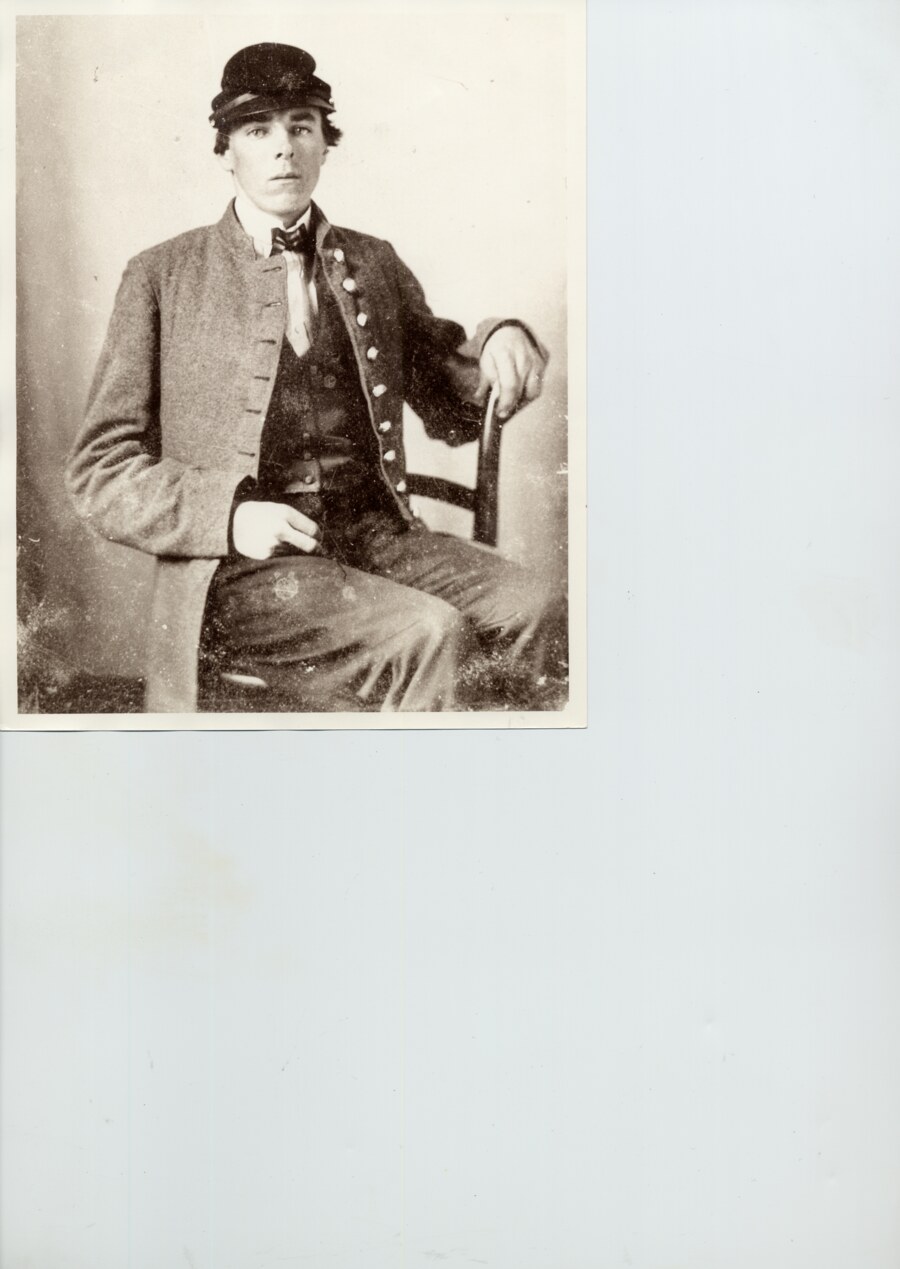
Channing Meade Smith N M V K Y [Insert Photo Here] Photo: Group photo at reference.[3565] Individual photo provided by Samuel Hopkins. In Lynn’s computer; in Alien; Hardcopy in Photos Binder; scanned to BHC photos folder. Use last for book. Dink Godfrey has an individual photo of him that, I think he said, is different from our hardcopy photo.[3566] Born: 22 May 1842,[3567] [3568] “at “Llangollen,” northwest of Upperville, in Loudoun County, Virginia.”[3569] Named after Bishops Channing Moore [3570] and William Meade.[3571] Married: William A. Jennings, Clerk of the County Court of Fauquier County, issued a marriage license on 25 November 1867 to Channing Meade Smith and Lucy Davenport Smith, and they were married by T. D. Blackwell [3572] on 12 December 1867. She was born in Fauquier County. Channing was age 25 and Lucy age 21 when they married.[3573] Channing wed Lucy Davenport Smith [12 December 1846–25 November 1923 [3574]], on 12 December 1867, Lucy’s 21st birthday, at “Chelsea,” the home of her parents, Mary (Glascock) and William Smith. Channing and Lucy lived in his parents’ Upperville home until 1875, when they moved to “Montana,” near Delaplane.[3575] [3576] Lacy Blackwell Smith (1847–?), married Channing Smith in 1866.[3577] The family bible record states, “Mrs. Lucy D. Smith died at Laurel, Maryland,… at the home of her daughter Mrs. Nelly Welling,” but Channing’s grandson says that she died of cancer, in Virginia, in her 60s, circa 1916. “I just barely remember her.”[3578] Note: Lucy would have been age 70 in 1916 or age 77 in 1923. They are buried together. [3579] Died: Monday, 7 November 1932.[3580] 8 November 1932. [3581] Buried Emmanuel Episcopal Church,[3582] Delaplane.,[3583] at the intersection of Routes 17 and 713.[3584] Obituary: With headlines announcing Roosevelt’s election to President, his obituary below in the middle of page one reads: “Mr. Channing Meade Smith … was a distinguished scout in the Confederate army, serving both in the Black Horse and under Colonel Mosby.”[3585] See Obituary Chapter. Children: His seven children, according to one source, were: William Adolphus, who was twice married. He had one child by his first marriage and two sons by his second marriage, which was to Ida Stevens. Robert Chilton, died without issue. [Robert never married; his middle name was Chilton.[3586]] The following sources contradict his middle name. Mary Elizabeth, died without issue. Ellen Powell, wed Clinton Welling. Roberta Chilton, wed Sam Hopkins. Susie Atkinson, no children. David Blackwell, wed Mildred Leachman.[3587] The following record of his eight children comes from Channing’s bible. The first three were born at Upperville; the last five at “Montana”. William Adolphus (2 December 1868– ), given the same names as his grandfathers. [William Adolphus “died in St. Louis, Missouri.” [3588]] Robert Channing (10 August 1871–24 May 1889), who died at Raccoon[3589] Ford in his nineteenth year. [“Robert B./ son of/ Channing M. and/ Lucy D. Smith/ Aug. 19, 1871/ May 24, 1889.” [3590]] Mary Elizabeth (14 December 1873–14 July 1902), given the same name as her mother’s sister, died unmarried, age 28. [“Mary Elizabeth/ Beloved Daughter of/ Channing M. & Lucy D. Smith….” [3591]] Ellen “Nelly” Powell (12 August 1875–after 1932), wed Clinton E. Welling. Lucy [and Channing[3592]] died at her home. Roberta Chilton (27 May 1877–19 November 1912), given the same name as her father’s sister, gained a brother on her ninth birthday; wed Samuel H. Hopkins, Sr. Susie Atkinson (15 October 1878–[30 September 1962 [3593]]), authored a Methodist Illustrated Lesson Paper at age ten. [She never married.[3594]] David (4 August 1881– ), given the same name as his mother’s brother. Harry Lee (27 May 1886–[28 October 1944 [3595]]), given the same name as Genl. Lee’s father, wed Minnie Thomas Delaplane.[3596] See Other Family, below, for more on Channing and Lucy’s children. Parents and Siblings: “Channing’s mother was Ellen Powell Chilton.”[3597] Channing was “son of Dr. Smith, Upperville, …”[3598] He “was the fifth child of Dr. Adolphus Cornelius and Ellen Powell Smith.”[3599] They were married on 11 October 1832 in Winchester.[3600] Channing’s parents were Eleanor or Ellen Powell (Chilton) and Dr. Adolphus Cornelius Smith. They wed when she was 17. “During the first ten years of marriage, Dr. A. C. and Ellen Powell had five children: a son, who may have died in childhood”; two daughters; Ellen D. (1837– ); Channing Meade. “These children grew up in a cultured home during one of Virginia’s most prosperous times…”[3601] “Channing had two older brothers… [who] died in infancy.” They were: William Lee Smith, died on 26 September 1833, 5 weeks old; Robert Brooke Smith, died on 20 April 1839 as an infant. “They are buried at Moss cemetery.” His sisters were Ellen Douglas Smith (25 August 1835–3 March 1925) and Roberta Chilton Smith (5 February 1840–5 March 1925).[3602] It is said that Mrs. and Dr. Adolphus Smith “were buried in the family cemetery,” site not found.[3603] However, a later source states that A. C. Smith (May 1807–9 October 1867) and Ellen Powell (Chilton) Smith (13 March 1813–28 May 1898) are buried at Moss Cemetery on Trapp Road near Upperville.[3604] Other Family: Channing’s maternal grandparents were Sarah Harrison (Powell) and Judge William Chilton of Loudoun County.[3605] She was daughter of the founders of Middleburg,[3606] Sarah (Harrison) and Col. Leven Powell of “Llangolen”. [3607] William was also Virginia States Attorney.[3608] He was son of Sarah (Orrick) and William Chilton.[3609] Channing’s paternal grandparents were Ann or Nancy (Taylor) and Dr. Thomas Williamson Smith. Her parents were Sarah (Rust) and Mandley Taylor. Thomas’s parents are not known.[3610] Thomas “was born in Virginia in 1782” and Ann “was born in Loudoun County…” “In 1802 he purchased two lots in Springfield, Hampshire County, now West Virginia.” He and Ann Taylor wed circa 1805. In 1807, “one Thomas W. Smith of Virginia attended” the Medical College of the University of Pennsylvania, Philadelphia. Dr. Thomas Smith purchased land in Loudoun County on 10 December 1811. They resided in Upperville by 1820. In Loudoun, Thomas owned at least three structures: a “big white house,” white plaster over stone, which was “several doors east of” his office, and a store “across the street from his house.” In addition to being “Upperville’s first practicing physician” and “a country merchant,”[3611] he owned several plantations, including the Upperville property, “Providence”, “Southwood Farm” and a property previously owned by Sally and James Rust. “Dr. Thomas Smith of Upperville… [was] well educated, something of a philosopher, well-to-do, a contributor to the founding of the Seminary in Virginia, apparently well connected, and somewhat proud…” He and Ann had three children—Eliza (1810– ), who wed a Mr. Brooke, and sons Adolphus Cornelius (1808– ) and Thomas, Jr., (1820– ), both of whom attended the same school as their father and became doctors. Channing’s father, Adolphus, “received his medical degree in 1831.” His family does not appear “in the 1850 Census of nearly twenty counties. Could he have joined the movement to the [deeper] South…? Many Virginia families did so, among them at least one part of the Chilton family [of which Channing’s mother was a member]…[T]his would satisfy the tradition that they were from Louisiana… “[I]f they went, why did they return?… Dr. T. W. Smith died in 1850, leaving a large and complicated estate.[3612] Part of the land was divided in 1853. Possibly they returned to Virginia at this time…” The 1860 Census shows the family in “Salem, now Marshall, Fauquier County.” “Shortly after the opening guns at Manassas, he [Adolphus] went to Richmond and was appointed a Surgeon in the Confederate forces. In 1862 he was appointed Medical Officer in Charge, Way Hospital, Lynchburg, Virginia. [“Adolphus served as a surgeon at the hospital center… for most of the war. He had the rank of Major.” [3613]]… With the city nearly surrounded, all medical supplies became exhausted and the surgeons were forced to operate without anaesthetics and pain-deadening drugs. Dr. Smith then hypnotized his patients to alleviate as much pain as possible when he operated.” In Lynchburg, on “Jany 1 1863”, Adolphus wrote: “I will and bequeath my gold watch to my son Channing M. Smith, should I die before the termination of the present war. Should we both survive the war, it is my intention to present it to him at its close, for his gallantry & Noble conduct in many trials and dangers, incident to his position…” “In the early summer of 1865 both Channing and his father returned to their normal pursuits…” Channing’s sister, Ellen D. Smith (1837– ) “was a teacher and never married…[S]he was educated far above the average country teacher and was much appreciated by both the students and their parents.”[3614] Channing’s sister Roberta married Joseph Weaver on 26 July 1860. He was the great-great-great-grandson of Tilman Weaver of Germanna.[3615] They named one of their six children Channing Meade Weaver.[3616] Sadly, Channing’s sisters died within two days of one another. “Ellen’s night gown caught on fire from a wood stove and she burned to death. Roberta had a heart attack and died before Ellen was buried.”[3617] Ellen, Roberta and Joseph are buried at Thompson Hollow near Bentonville, Warren County.[3618] One source states that one of Channing’s sisters married the “only person in Fauquier County who supported Lincoln.”[3619] However, Channing’s only known brother-in-law, “Joseph Weaver… was an ardent secessionist.…” The Weavers served in the Confederacy. “Joseph was a first cousin to three brothers—Capt. Virgil Weaver, 6th Va. Cav., killed in action at Todds Tavern; Horace Weaver, 6th Va. Cav., and Mortimer Weaver, 4th Va. Cav.”[3620] Channing’s mother, Ellen Powell (Chilton) Smith’s brother was “Brig. Gen. Robert H. Chilton of R. E. Lee’s staff. Robert was Channing’s uncle.”[3621]
One source states that Channing was related to Robert Lee, Channing having decended from Hancock Lee, and General Robert E. Lee from Richard Lee.[3622] Another says that Channing was “a kinsman of Governor William Smith of Virginia.”[3623] If the latter is true, this would have been “Extra Billy” Smith (1797–1887), governor during 1846–1849 and 1864–1865, and a Confederate general.[3624] Channing’s wife’s brother was William Aquilla Smith [BH], and her sister wed William Henry Lewis [BH]. After all of Channing’s war-time escapades with the Lewis brothers (as told at Channing’s Stories, Biographies, & Letters heading, below), the trio became brothers-in-law by the marriages of two of the men to sisters. William Smith, who would also have been Channing’s brother-in-law, had died during the war, well before Lucy and Channing’s marriage. See her brother William Aquilla Smith [BH] for more on Channing’s wife’s immediate family and her maternal genealogy. See her uncle Isaac Eustace Smith [BH] for her more on father’s immediate family. See her uncle Anderson Doniphan Smith [BH] for her paternal genealogy. A bit more about each of Channing and Lucy’s children follows. Three of their sons—William, Robert, David—went to St. Louis, Missouri, “to seek their fortunes.” The most successful in Missouri was the oldest, William Smith. He became an electrical engineer. He wed “the daughter of the man who built a bridge across the Mississippi River.” He remained in Missouri. Robert returned to Virginia. He and his sister Mary [3625] died of diptheria. He died in Warrenton or Little Washington, and is buried in Warrenton. David Blackwell Smith was successful in Missouri with International Shoe Company. He returned to Warrenton in 1927, circa age 35 or 40. He bought a place called “North Rock,” and became president of the Warrenton Horse Show. He was wiped out during The Depression, and afterwards worked with Blackwell Construction, which was owned by his grandmother’s family. He sold “North Rock” and moved to Little Washington. Channing’s daughter Roberta was active and athletic, like Channing. Susie taught school in Marshall for years. Sue was very good at telling children’s stories. Channing lived with Nel in Laurel, Maryland. Later, Sue Smith, Nel’s sister, lived there. Harry had a Ford dealership in Marshall (originally Salem). His wife, Minnie Delaplane, was a rural mail carrier. The farm belonged not to Channing but to Channing’s wife, Lucy, so “Montana” was inherited by their children. When Lucy passed on, the children decided that Harry would get the farm. Channing did not get along with his daughter-in-law, so Channing moved to Laurel.[3626] Channing’s grandchildren were: Elizabeth, Channing, Jr., and William Adolphus, Jr., (William); Truman and Lucy (Ellen); Sam, James and Martha[3627] (Roberta); Mildred, David and Harry Lee (David). [3628] Another source gives as his grandchildren: Trueman Crofs Welling and Lucy Smith Welling (Ellen); Samuel H. Hopkins, Jr. (Roberta); Minnie Delaplane Smith and Harry Lee Smith, Jr., (Harry). This source records another life—George Albert Smith, born Delaplane, 30 June 1921, died 22 July 1922.[3629] “George, who died in infancy,” was son of Minnie (Delaplane) and Harry Lee Smith, Jr. [3630] Some of this cavalyman’s decendants transplanted to other places. Channing’s grandson Channing, son of William Adolphus of Missouri, “was a well-known artist.” His granddaughter Lucy became Mrs. Lucy Smith Boss of Laurel, Maryland.[3631] David’s son, David Blackwell Smith, Jr., married and lived in Illinois; he died “a few years ago.” [3632] Channing’s granddaughter Mildred Leachman (Smith) wed William Louis Litsey, author of a compilation that provides much of the genealogical data used for Channing’s entry herein.[3633] Mildred lives in Norfolk, Virginia. [3634] [3635] Others of Channing’s decendants resided at “Montana” into the second millenium.[3636] Channing’s granddaughter, Minnie, inherited “Montana” from her parents. She died “only a couple of years ago.” Her brother Harry then inherited “Montana.” His widow and children live near Little Washington. No one lives on the farm now.[3637] Stories, Letters & Biographies: Individuals who enjoy biographical history may count among blessings that a wealth of tales about this cavalryman’s actions has been preserved to the present day. Not only does this large record of the events in which he was involved reveal details of his own service and war-time life, but also, importantly, it stands representative of the deeds and experiences of the many soldiers about whom little or nothing is known. Channing was a scout, that is, a spy for the Confederacy. He worked separately and often an a fair distance from his unit; therefore, he regularly composed reports detailing what he saw and did in the form of letters to his superior officers. Years later, he recounted his adventures for a civilian audience for publication in periodicals. Historians and his decendants have preserved the military reports and the articles, to the benefit of individuals who may desire to know Channing and those who wish to learn about another ancestor’s era. Every effort has been made to arrange these tales chronologically. To present this wealth in a way that it might be easily absorbed and appreciated, each of Channing’s Stories has been given an italicized subtitle. A sampling of each tale with its subtitle follows. Each may be located by the subtitle at the noted chapter. Where no chapter is noted, the balance of the tale can be found at the Stories Chapter. Channing writes, “the Black Horse Company was encamped on Mr. Ware’s farm…” [3638] See Camp life: “a peck of dirt”; “[D]etailed in May 1863 as special scout for Generals Lee and Stuart …”[3639] See “I know he got my message”; He disliked entering enemy lines solo.[3640] See “had his own way of doing things”; He displayed “a perfect nonchalance under circumstances of great personal danger calculated to shake the stoutest hearts.”[3641] See Letters Chapter.
“Along the way, Smith had gathered vital information; captured a supply wagon,… ; and somehow managed to carry off a flag…, which he presented to General Lee.” [3642] See “Along the way…”; “Lewis went to Fauquier… [W]ill go… myself tomorrow… I wrote to Col. Randolph for another [man].” [3643] See Letters Chapter. Channing wrote this report on 10 April 1864, a few days before he and two other cavalrymen overcame a larger group of yankees near Catlett, Fauquier County. Read about that incident in Stories Chapter: Channing “joined Richard H. Lewis and [James Monroe Love[3644]]…”[3645] See “Three Scouts, Five Federals”; “I know you Black Horse boys pay no attention to records, but rely entirely upon your memory, … [Y]ou had better keep for the benefit of your family [this] record of General Stuart complimenting you. …“[3646] See Letters Chapter under Richard Lewis. J. E. B. Stuart “recounted with praise the exploits of Channing Smith… .”[3647] See J. E. B. Stuart praises Channing Smith; “…Channing Smith wrote two articles describing his exploits… near Grant’s own headquarters… .”[3648] See “What cavalry is that?”; “He changed his sentence just in time…”[3649] See Humane act; Smith’s usefulness to Lee: See “…but soon he received a dispatch”;[3650] “[T]he birds in our leafy canopy sang sweeter,…”[3651] See Return on Charity; “After the… fighting at Spotsylvania…”[3652] See “roused before midnight”; “Sir: I respectfully ask that Pvt. Channing M. Smith… be transferred to… my command… for promotion.”[3653] See Letters Chapter. “Noiselessly raising the window they stepped upon the roof which, being covered with sleet, crackled beneath their tread… Click-click, went innumerable carbines and revolvers.”[3654] See Stories Chapter under Richard Lewis. “When Mosby heard of the surrender…”[3655] See “he sent Smith to Lee”; “‘Channing,’ replied the General, ‘go home, all you boys who fought with me, and help to build up the shattered fortunes of our old state.’” [3656] See “Go home.”; “I found him active, bold, faithful, and intelligent…”[3657] See Letters Chapter. “…I knew Gen. Robert E. Lee very well during the war between the States… .”[3658] See “I knew Lee well”. “William Keith Skinker was a farmer. But during the Civil War…”[3659] See Stories Chapter under William Keith Skinker. Channing wrote “An Interesting War Incident During the ’60s.”[3660] See Stories Chapter under William Henry Fitzhugh Payne, “But what will we do for arms?” This cavalryman was one of nine who joined to announce the 1890 Reunion. See discussion of the Reunion Photograph at the Introduction. Channing wrote Joseph B. Boteler’s obituary. In this obituary, Channing follows a composition pattern that he employs often in his Confederate Veteran articles: an opening paragraph, next a piece of verse, then the body of the story. See Obituary Chapter under Joseph B. Boteler. Channing’s Confederate Veteran articles included: “An Adventure Within Grant’s Lines,” vol. XXIX, no. 11–12 (November–December, 1921): 426–427; “In Deadly Peril,” vol. XXX, no. 6 (June, 1922): 222–223; “The Last Time I Saw General Lee,” vol. XXXV, no. 9 (September, 1927): 327. Other Confederate Veteran articles written by or about him appear in vol. XXI, no. 5 (May, 1913): 214; vol. XXIII, no. 6 (June 1915): 265–266; vol. XXVIII, no. 3 (March, 1920): 119 and no. 5 (May, 1920): 189; vol. XXIX, no. 1 (January, 1921): 35, no. 2 (February, 1921): 62–63, no. 4 (April, 1921): 136–137, no. 6 (June, 1921): 212, no. 9 (September, 1921): 340–341 and no. 11–12 (November–December, 1921): 426–427; vol. XXX, no. 6 (June, 1922): 222–223, no. 8 (August 1922): 282, 308 and 318; vol. XXXI, no. 5 (May, 1923): 188 and no. 9 (September, 1923): 356; vol. XXXII, no. 7 (July, 1924): 286; vol. XXXIV, no. 2 (February, 1926): 227 and no. 6 (June, 1926): 228; vol. XXXV, no. 9 (September, 1927): 327 and no. 7 (September, 1927): 348; vol. XXXVI, no. 7 (July, 1928): 266 and no. 11 (November, 1928): 416–417; vol. XXXVII, no. 3 (March, 1929): 105; vol. XXXX, no. 3 (March, 1932): 100–102.[3661] See Biographies Chapter for a sketch from The Library of Virginia that recaps some of the keynotes of Channing’s life. He lived late enough for his equally long-lived grandchildren to have known him well. His grandson says of him, in 2006….[3662] See Biographies Chapter. Channing M. Smith is mentioned at reference.[3663] Readers might also find more information about Channing at following reference.[3664] CSR: Enlisted 25 April 1861; horse badly wounded 4 October 1861 Pohick Church; detached as scout July 1863 to April 1864; transferred to 43rd Batt. Cav. 12 November 1864; wounded twice. Additional Information: “In the Census of 1860 he was listed as a student.” By the next year, “Channing, at the age of 19,… [was] a trooper of the Fourth Virginia Cavalry Regiment, called the “Black Horse Cavalry”.”[3665] [3666] Channing’s Muster Roll with the Black Horse Company: 25 April 1861, enlisted. September and October 1861, present. On picket at Pohick Church 4 October 1861. Horse badly wounded by musket ball. November and December 1861, absent. On detached service as clerk for Col. B. H. Robertson 4th Cavalry. January and February 1862, absent. On furlough. November and December 1862, on roll, no comments. March and April 1863, on roll, no comments. July and August 1863, absent detached scout. September and October 1863, absent detached scout. 25 September 1863, furlough, 60 days. January and February 1864, absent. Abs. Scout for Gen’l Stuart. March and April 1864. Absent Detailed scout for Gen’l Stuart. 1 April 1864, Absent. Absent Detailed scout for Gen’l Stuart. 12 November 1864. Transferred from Co. H, 4th Virginia Cavalry as Private to Co. E., Col. Mosby’s Battalion as Lieutenant. Channing’s Muster Roll with Mosby’s Regiment: 9 December 1864. Appears on a Register containing a List of Officers who were Promoted for Valor and Skill. 10 December 1864. On roll as enlisted in Fauquier on 12 November 1864. “The Adjutant and Inspector General’s Office, Confederate States, contains information relative to the man named, on the subject mentioned above,” as follows: “Channing M. Smith (not found as Channing Meade Smith), pvt. Co. H, 4th. Regt. Va. Cav., C. S. A., enlisted at Warrenton Apr. 25, 1—1 [1861], and on the last roll in file for March and April 1864, was shown absent, scout for Gen. R. E. Lee. “The records show that Sept. 25, 1864, Lt. Col. John S. Mosby, 43d. Battn. (subsequently Mosby’s Reg’t) Va. Cav., C. S A. requested that private Channing M. Smith, Co. E, 4th Va. Cav., C. S. A., be transferred to the 43d Battn. Va. Cav., C. S. A., for promotion. “A Report of an inspection of the muster rolls of Co. E, Mosby’s Regt. Va. Cav., C. S. A., dated Dec. 10, 1864, shows: Channing Smith, pvt., born in Fauquier Co., Va, enlisted at Fauquier Nov. 12, 1864. The records also show that Dec. 6, 1864, Channing M. Smith was recommended for promotion to 2n [Second] Lieut., Co. E, Mosby’s Regt., Va Cav., for valor and skill and it is stated that he had been severely wounded at Leesburg ——— ——— ———. No later record had been found for this man as [being] of Mosby’s Regt. ——— [of] Cav., C. S. A. “A roster of the 1st, Battn. Va. Inf., C. S. A., dated Feby 17, 1865, shows: C. M. Smith; remark,—is applying to fill the vacancy in Co. B. Union Prisoner of War records show: C. M. Smith, 2n Lieut., Co. B, 1st Va. Battn., paroled at Appomattox Court House ———, April 9, 1865.”[3667] A handwritten note beside these last two statements states: “not my Channing.”[3668] Another Channing M. Smith was Channing Moore Smith, born 15 October 1843, son of Ann Marie Goodwin and Rev. Thomas Smith. This Channing lived at Parkersburg and never married.[3669] Also, one Lt. Channing M. Smith is listed as being of the First Battalion, Virginia Infantry, Co. B, and having written a diary dated 10 March to 23 April 1865.[3670] This or these men and the Black Horse cavalryman were not the same person. Channing Meade Smith [BH] “was with… [Stuart] on the historic ride across the rear of Gen McClellan’s forces…During the Battle of Fredericksburg, he acted as courier and scout for General Lee… After the defeat at Gettysburg in 1863, he was a part of the screening force which held off the Northern forces until Lee crossed the Potomac.” Channing “lost several horses, had holes shot in his clothing several times, but… [was] seriously wounded only once.” [3671] Many sources attest to his membership with Co. H and gallant service: He was wounded in detached service, scout. [3672] Scout for General Stuart.[3673] Channing Smith was a member of the “Black Horse” Cavalry, C. S. A.; he was twice wounded. He was “one of Stuart’s most valued scouts.”[3674] Cited for gallantry by Genl. J. E. B. Stuart, and Genl. R. E. Lee.[3675] Third Lieutenant.[3676] “Entered the Confederate Army in April 1861 as private in the Black Horse Cavalry and became a scout under Gen’l. J. E. B. Stuart. Later, after recovering from [a] severe wound received at Leesburg, he became a Lieut. in Co E, 4rd Virginia Battalion (Mosby’s Battalion).”[3677] “3rd Lieutenant Channing M. Smith—Before joining Mosby’s command Channing had served in Company H, 4th Virginia Cavalry, receiving both praise and recognition as a scout from both Generals Lee and JEB Stuart. “After the war, he resided at Delaplane, Virginia…” [3678] Channing’s marriage license shows his occupation as farmer in 1867.[3679] He resided at Delaplane in mid-1870s. [3680] “One of the prominent Confederate scouts attending the reunion is Channing M. Smith of Delaplane, Va.”[3681] Channing bought the plantation “Montana” and was a farmer. He practiced law for a while,[3682] and “he was a clerk for the Marshall School Board.” [3683] He was restless. He retired early and lived with his daughter Nel [Ellen Powell (Smith) Welling].[3684] He moved from Delaplane to Warrenton between 1922 and 1927.[3685] Channing “wrote… for The Fauquier Democrat.”[3686] Some war-related items that were owned by Channing still exist in the possession of his family.[3687] “Mr. C. M. Smith of Warrenton, and Mr. Edward Armstrong of Waterloo, attended the reunion at the home of Mr. W. B. Wood of Sperryville, last Saturday to which the veterans of six counties were invited. The day was enjoyed by 21 Confederate veterans and some visitors.”[3688] Channing was: his parents’ only son, younger brother to several older sisters[3689]; student, soldier, spy; farmer, lawyer, clerk, author. He was adventurous, articulate, ethical, compassionate, charismatic, poetic. “Fine letter of Channing M. Smith re: Ox Hill, in Box 22, John Warwick Daniel Papers, U. Va — Nov. 5, 1905.”[3690]
This entry contains 127 footnote references. The full bibliography is in the References section.
Channing Meade Smith. Courtesy Sam Hopkins.
Source Rosters
- N Swearing-in Roll (10 May 1861)
- M Martin Roll (most authoritative)
- V Vanished Roster (~1874–1878)
- K K.I. Keith Roster (1924)
- Y Nanzig Register
Descendant or researcher? Corrections and additions welcome.
Suggest a correction →From A Biographical Register of the Members of Fauquier County Virginia's Black Horse Cavalry, 1859–1865. Compiled by Lynn C. Hopewell (1940–2006), with editorial assistance by Susan W. Roberts and research by Heidi Burke. Manuscript completed February 28, 2008. Published posthumously.